
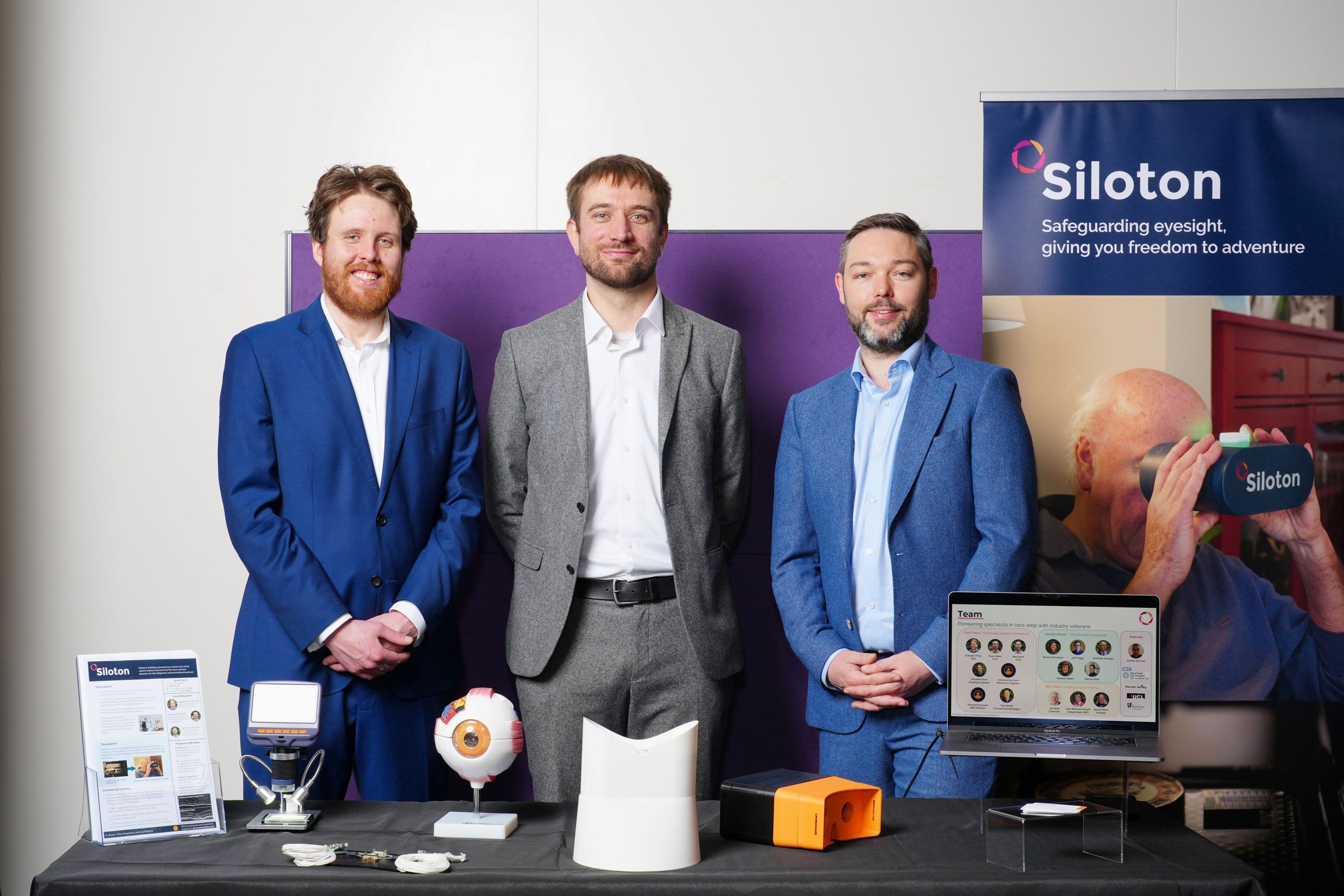
Latest round takes total funding to £1.7 million for retinal imaging technology, which could help prevent blindness.
Siloton, the Bristol-based health technology start-up, has secured £860,000 to progress the commercial roll-out of its groundbreaking eye imaging chip technology, which could help address the UK’s most common cause of sight loss.
The funding package will help Siloton to further develop its Akepa optical coherence tomography (OCT) chip technology and bring a version of the device for researchers to market in 2025. Later this year, the company is aiming to deliver a world first by capturing the first chip-based OCT image of a living eye in a commercial setting – a key milestone for its future use by clinicians.
Evenlode Foundation committed further capital in the latest round alongside members of the South East Angels, the Francis Crick Institute, and other experienced angel investors. They were complemented by non-dilutive funding from an Innovate UK Biomedical Catalyst grant, taking total funding in the company to date to £1.7 million.
Siloton’s technology aims to make the diagnosis and monitoring of a range of treatable retinal diseases more affordable and accessible, by compressing a tabletop-worth of heavy, expensive, and fragile components onto a single chip smaller than a £1 coin. The technology could save the NHS over £1 billion annually and allow patients to monitor their condition at home, rather than having to regularly attend hospitals.
Conditions such as wet age-related macular degeneration (AMD), retinal vein occlusion, and diabetic macular oedema affect millions of people worldwide, putting them at risk of blindness. In the UK, AMD is the largest cause of sight loss, according to the Macular Society, with around 39,800 people developing wet AMD each year
Dr. Alasdair Price, CEO of Siloton, said: “Siloton has brought together a uniquely qualified team that is able to drive forward technology development at an unprecedented pace. This new support will help us take the next step towards commercialisation by shifting gear from R&D to product development.
The population of individuals with retinal disease is growing. New, more affordable and accessible OCT systems like our Akepa technology will be critical to serving patients with precision and efficiency. In turn, this could help reduce preventable blindness, save healthcare providers billions of pounds, and reduce pressure on already stretched eye clinics.
We are on the cusp of a significant milestone with our technology and look forward to sharing this in the not-too-distant future.”
Media enquiries:
For more information, please contact:
Peter McFarlane
peter@syncopatedcomms.co.uk
07412 739 093
About Siloton
Siloton is on a mission to ensure people with eye disease can receive sight-saving eye scans wherever and whenever they need it. Siloton’s photonic chip technology will transform clinical-grade medical imaging systems into devices that can be accessed anywhere. They are supported by a number of key players in the ophthalmology space, including Moorfields Eye Hospital and the Macular Society. Their customers include the European Space Agency, who need a long-term solution to monitoring eye problems that astronauts frequently develop while in space.
Siloton closed its second investment round in July 2024, raising c. £860k to fund the development of an imaging setup for acquiring its first live eye image. This funding will also support ongoing revenue generating activities and ISO13485 accreditation.
To find out more, visit www.siloton.com or follow updates on Siloton’s LinkedIn page.
About Akepa
Akepa is Siloton’s first-generation OCT chip, comprising over 300 optical and electronic elements. With approximately 70% of the OCT system on-chip, this is already at the same level of integration as will be required in the final product. Akepa was fabricated in a commercial foundry, providing a clear route to high-volume manufacture at the scales required for widespread monitoring and treatment of retinal disease.